
Whether you’re launching a new instant noodle brand or scaling an existing factory, choosing the right instant noodles machine — or a complete instant noodles production line — is the single biggest decision.
What Is an Instant Noodles Machine?
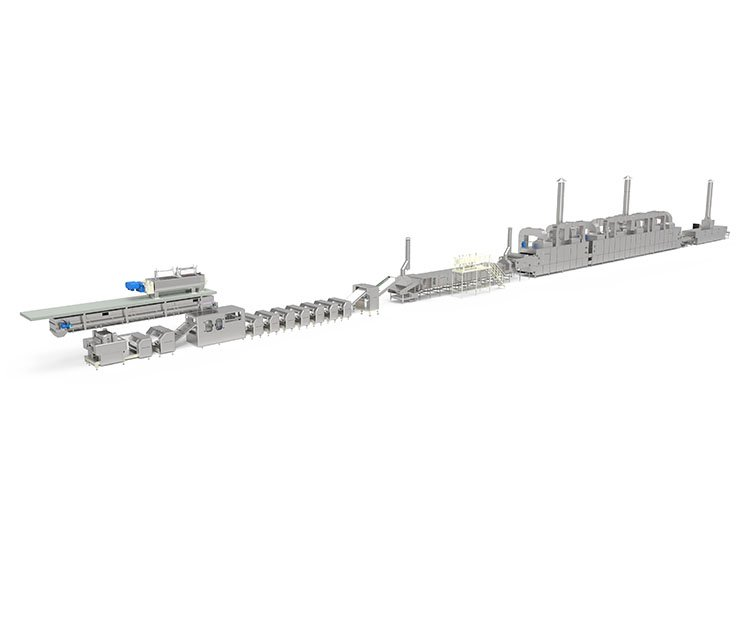
An instant noodles machine is any piece of food processing equipment designed to perform a specific stage in the manufacturing of instant noodles — typically a category of pre-cooked, dried, and seasoned noodle products that consumers can prepare in 3–5 minutes by adding hot water.
In industrial practice, the term covers everything from a standalone noodle dough mixer to a high-capacity continuous steamer. When several of these machines are connected into one integrated workflow, the system becomes what the industry calls an instant noodles production line.
Instant Noodles Machine vs. Full Production Line: What’s the Difference?
One of the most common mistakes first-time investors make is confusing these terms. Understanding the differences between them will help you develop a funding plan, factory layout, and product launch timeline.
Single Instant Noodles Machine
A single machine performs one step of the workflow. Examples include:
- Vacuum noodle dough mixer (capacity: 50–400 kg per batch).
- Continuous noodle steaming tunnel.
- Automatic noodle folding & forming machine.
- Batch fryer or hot-air dryer for noodle dehydration.
Buying individual machines is appropriate only when you already operate a line and need to upgrade or replace one station. It is rarely recommended for new factories.
Full Instant Noodles Production Line
A complete instant noodles production line is a turnkey, end-to-end system that handles the entire process automatically — from raw flour input to finished, packaged product ready for distribution. It includes all machines, conveyors, control cabinets, seasoning systems, packaging equipment, and centralized PLC automation.
| Factor | Single Instant Noodles Machine | Fully Automatic Instant Noodles Production Line |
|---|---|---|
| Process coverage | One step | All steps end-to-end |
| Automation | Manual / semi-auto | Fully automated via PLC |
| Labor required | High | Low (2–4 operators) |
| Investment level | USD 5K–80K per unit | Depending on capacity |
| Best for | Upgrades or pilot R&D | Commercial mass production |
For any commercial-scale operation, a complete instant noodles production line is the standard. It gives you consistent quality, predictable output, and one single supplier accountable for performance — instead of coordinating 7–10 different vendors.
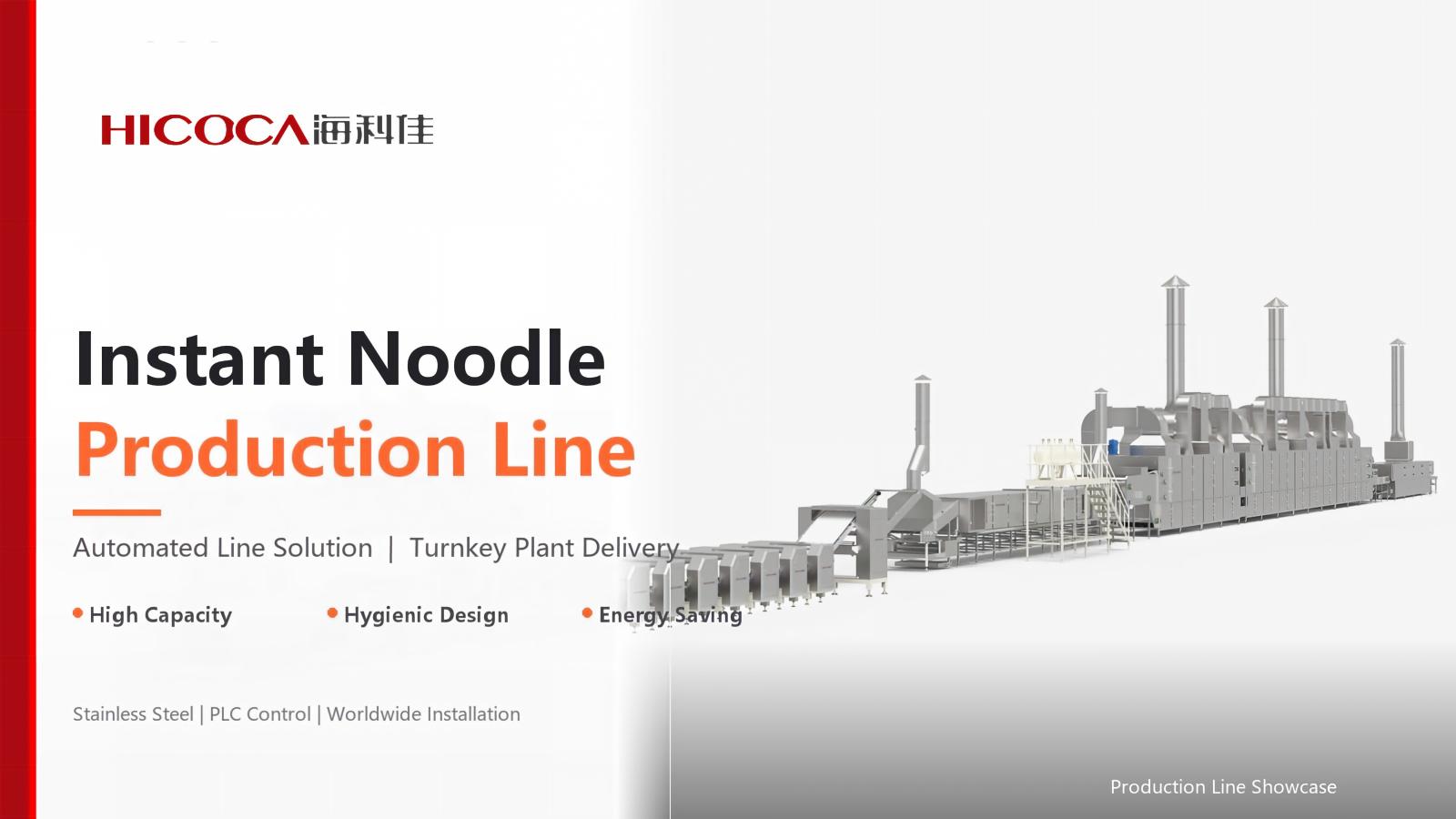
The 7-Step Instant Noodles Production Line Workflow
Every instant noodles production line — fried, non-fried, bag, cup, or bowl — follows the same seven fundamental stages. What changes between product types is the equipment at steps 6 and 7. HICOCA engineers each line so that these stages flow seamlessly with minimal manual handling.
1 Step 1: Dough Mixing
The requirement for dough kneading is to form a dough with good processing properties. That is, the dough should form a granular shape, absorb water evenly and sufficiently, have appropriate gluten development, be loose in size, uniform in color, and have a slightly yellowish-brown hue.
2 Step 2: Ripening
Increasing the formation of the gluten network makes the noodles more chewy and elastic.
3 Step 3: Rolling & Compounding
The dough passes through a series of roller pairs that progressively reduce sheet thickness while building the gluten structure.
4 Step 4: Shredding
Calibrated slitting cutters convert the continuous noodle sheet into uniform strands — the width here directly defines your final noodle gauge.
5 Step 5: Steaming
A continuous steamer gelatinizes the starch and pre-cooks the noodles. Steaming time and temperature are critical to the final bite texture.
6 Step 6: Cutting
Cut the instant noodles into pieces for further processing.
7 Step 7: Frying or Hot-Air Drying
This is the defining step. Fried noodles pass through a continuous fryer at 140–160°C for 60–90 seconds, dropping moisture to below 5% and creating the porous microstructure. Non-fried noodles use hot-air dryers instead, producing a healthier product with lower oil content.
8 Step 8: Cooling & Packaging
After cooling, each noodle cake is paired with seasoning sachets and packed automatically — as bag noodles, cup noodles, bowl noodles, or bulk packs.
HICOCA design principle: Every HICOCA instant noodles production line integrates all steps through a single PLC control system, so your operators monitor the entire process from one HMI panel.
Types of Instant Noodles Production Lines: Fried, Non-Fried, and Cup/Bowl
Choosing the right type of instant noodles production line is the first specification step. It dictates the equipment downstream of steaming and therefore drives cost, footprint, and energy use.
Fried Instant Noodles Production Line
The classic category: noodle cakes are flash-fried to drive moisture below 5% while creating the familiar porous micro structure that rehydrates in 3 minutes. Most globally recognized instant noodle brands use this format.
- End product: bagged and cup noodles with rich mouthfeel.
- Shelf life: 6–12 months.
- Best for: mainstream markets where texture is the priority.
Non-Fried Instant Noodles Production Line
Uses hot-air drying instead of frying. Noodles retain less oil and are marketed as healthier or “better-for-you.” Demand is growing rapidly in Europe, North America, and parts of Asia.
- End product: air-dried bag or cup noodles.
- Shelf life: 9–12 months.
- Best for: health-conscious consumers and export markets with strict oil regulations.
Cup & Bowl Noodle Production Line
A specialized variant of the fried or non-fried line, with additional equipment for cup/bowl forming, filling, sealing, and lid placement.
- End product: single-serve cup or bowl noodles.
- Best for: retail, ready-to-eat meals, and on-the-go consumption.
How to Choose the Right Capacity for Your Instant Noodles Production Line
Capacity planning is far more complex than it appears. Planning too small will hinder growth, while planning too large will tie up capital and raise the break-even point. A rule of thumb is to plan 1.5 times the current target, which leaves room for flexibility without overexpansion.
3 Practical Sizing Questions
1
What is your target market in the first 24 months? Domestic only, or also export?
2
What SKUs will you run? Each SKU changeover costs time. Multi-SKU operations need quicker changeover design.
3
What is your factory footprint? Vertical lines save space; horizontal lines simplify maintenance.
HICOCA’s engineering team works with you to model your exact ROI — factoring in labor, energy, raw-material yield, and downtime — before recommending a capacity.
Cost Breakdown of an Instant Noodles Production Line
Pricing varies significantly with capacity, automation level, material grade (e.g., stainless steel SUS 304 vs 316), and optional modules like cup-filling or multi-fryer tunnels. Below is an indicative range for planning purposes only.
What’s Included in HICOCA Quotes
- Full production line equipment, manufactured to your capacity target.
- PLC control cabinet + multi-language HMI.
- Factory layout design (2D + 3D).
- On-site installation supervision and commissioning.
- Operator training (theoretical + hands-on).
- Recipe development support for your product range.
- 1-year warranty
How to Choose an Instant Noodles Machine Supplier: 8-Point Checklist
The wrong supplier can derail a factory project for 12+ months. Apply this checklist when evaluating any instant noodles production line vendor.
1
Proven track record. Ask for reference clients, ideally in your country or region, and visit them if possible.
2
In-house manufacturing. Avoid trading companies. You want the factory engineering your line, not a middleman.
3
Engineering depth. Do they employ mechanical, electrical, automation, and food-process engineers in-house?
4
Customization willingness. Can they tailor the line to your specific product, SKU range, and factory floorplan?
5
Material transparency. Food-contact parts should be SUS 304 stainless steel or higher. Avoid carbon steel.
6
Automation standards. PLC brand, servo motor brand, and HMI quality matter for long-term reliability.
7
Installation support. On-site engineers or only remote guidance? The former dramatically reduces risk.
8
After-sales commitment. Warranty period, response time SLA, spare-parts availability, and remote diagnostics capability.
Out of every supplier question we receive, this is the one to take the most seriously: “What is the experience of your last three customers, and can you put me in contact with them?”
Why Global Manufacturers Choose HICOCA for Their Instant Noodles Production Line
Video: Instant Noodles Machinery Production Line
HICOCA is a Chinese-based, internationally focused manufacturer of food processing and packaging machinery. We specialize in instant noodles machines and complete instant noodles production lines, with installations in over 60 countries across Asia, the Middle East, Africa, Eastern Europe, and Latin America.
What Sets HICOCA Apart
- Turnkey delivery. From factory layout to recipe development, HICOCA owns the whole project.
- In-house R&D. Continuous improvements in energy efficiency, oil filtration, and PLC integration.
- Modular line design. Start small and scale up by adding modules — without replacing equipment.
- Global service network. Regional spare-parts hubs and on-site engineering support.
HICOCA Service Workflow
1
Consultation & feasibility based on your target capacity, product range, and budget.
2
Layout design — factory floorplan, utilities, and workflow integrated.
3
Manufacturing of your customized line in our own facility.
4
Installation & commissioning by HICOCA engineers on site.
5
Training & recipe development for your operators.
6
After-sales support — remote diagnostics, spare parts, and continuous optimization.
Post time: Aug-14-2026