
Cup noodles have become an important product category for food manufacturers looking to serve consumers who need convenient, quick-to-prepare meals. For manufacturers, producing cup noodles at an industrial scale requires more than a noodle-making machine. It requires a well-planned production process, reliable equipment, accurate portioning, and an efficient packaging system.
A modern cup noodle production line integrates noodle processing with cup filling, seasoning placement, sealing, and finished-product packing. Depending on the product design, manufacturers can produce fried or non-fried noodle cakes, different cup sizes, and various retail packaging formats.
In this guide, we explain how cup noodle production line works, introduce the main types of cup noodles machine, and discuss how to choose a reliable cup noodles packaging manufacturer and cup noodles production line supplier.
1 What Is a Cup Noodle Production Line?
A cup noodle production line is an integrated food manufacturing system designed to produce instant noodles packed in cups or bowls. It combines noodle processing equipment with cup handling, filling, sealing, and packaging equipment.
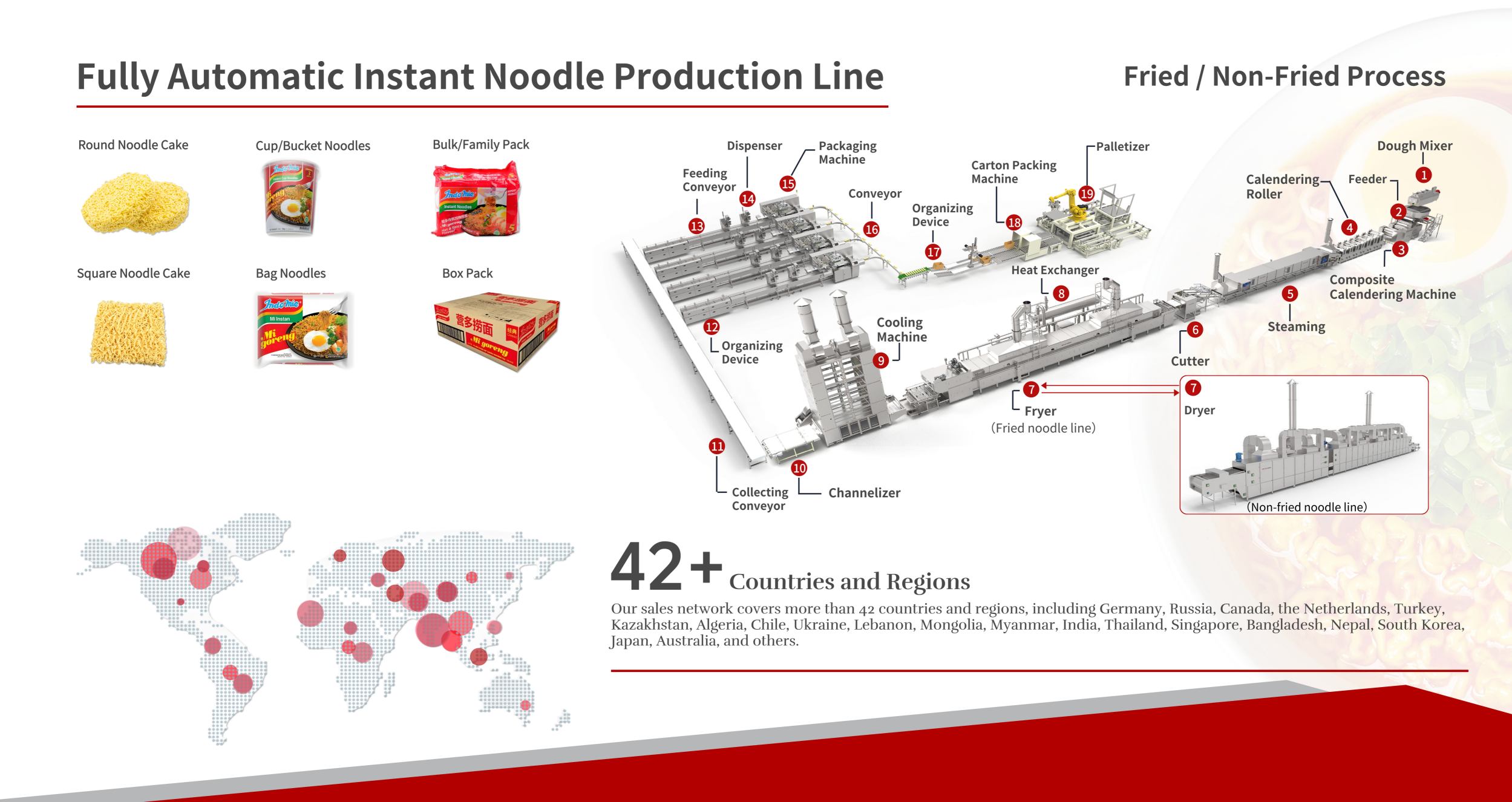
A typical cup noodle manufacturing project includes:
- Automatic flour feeding and dough mixing systems.
- Noodle sheeting, rolling, and cutting machines.
- Continuous steaming equipment.
- Frying or hot-air drying systems, depending on the noodle type.
- Noodle cake cooling and conveying equipment.
- Cup feeding and positioning systems.
- Noodle cake loading and seasoning dispensing equipment.
- Lid sealing or film sealing machines.
- Finished cup inspection and secondary packaging equipment.
2 How Cup Noodle Production Line Works
Step 1: Flour Feeding and Dough Mixing
The process begins with flour and other ingredients being prepared. Automated ingredient feeding and controlled mixing maintain more consistent product quality.
Step 2: Noodle Sheeting, Rolling and Cutting
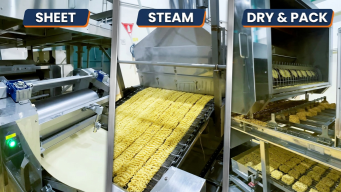
Dough passes through rollers to form a continuous sheet, which is reduced to thickness and cut into strands suitable for cup sizes.
Step 3: Steaming and Noodle Cake Forming
Noodles are steamed to cook the starch and portioned into cakes matching the cup design.
Step 4: Frying or Hot-Air Drying
Fried instant noodles: Moisture reduction via frying.
Non-fried instant noodles: Moisture reduction via hot air.
Step 5: Cooling and Transfer
Noodle cakes are cooled to stabilize the product before cup filling to prevent breakage.
Step 6: Cup Feeding and Noodle Cake Loading
Empty cups are positioned and noodle cakes are automatically loaded with high consistency.
Step 7: Seasoning and Ingredient Dispensing
Seasoning powder, sauce, or dehydrated vegetables are added via precise dispensing systems.
Step 8: Cup Sealing and Lid Application
Cups are heat-sealed with film or lids to protect contents and ensure package integrity.
Step 9: Inspection and Secondary Packaging
Quality checks for defects followed by grouping into cartons or multipacks for distribution.
3. Cup Noodles Machine: What Equipment Do You Need?
| Equipment | Main Function | Key Selection Factor |
|---|---|---|
| Dough mixer | Mixes flour and water | Batch size and mixing consistency |
| Noodle forming machine | Rolls and cuts noodle dough | Noodle specifications and output |
| Steaming equipment | Cooks the noodle strands | Processing capacity and control |
| Fryer or dryer | Reduces noodle moisture | Product type and energy requirements |
| Cooling conveyor | Cools noodle cakes | Cooling performance and transfer stability |
| Cup feeding machine | Supplies and positions cups | Cup size and feeding reliability |
| Noodle cake loader | Places noodle cakes into cups | Portion dimensions and loading speed |
| Seasoning dispenser | Adds seasoning or ingredients | Ingredient type and dosing accuracy |
| Cup sealing machine | Seals the cup opening | Cup and lid material compatibility |
| Secondary packaging machine | Packs finished cups | Carton format and required output |
4. Cup Noodles Packaging Machine: Why Packaging Matters
A cup noodles packaging machine is critical because it affects product protection and line efficiency. Key factors include reliable cup feeding, accurate ingredient placement, and consistent sealing performance.
5. Fried vs. Non-Fried Cup Noodle Production Lines
Fried Cup Noodles
Fast rehydration and characteristic texture. Focuses on frying capacity and oil management.
Non-Fried Cup Noodles
Uses hot-air drying. Focuses on drying capacity, energy consumption, and rehydration performance.
6. How to Choose a Cup Noodles Packaging Manufacturer
Check engineering experience, confirm production capacity, test actual materials, and review after-sales support.
7. How to Select Cup Noodles Production Line Supplier
Prepare this information before requesting a quote:
8. Why Choose HICOCA for Instant Noodle Production Solutions?
HICOCA provides automated noodle production and packaging solutions designed around specific manufacturing requirements. Their approach focuses on integrated production to achieve stable output and reduce bottlenecks.
Visit the official website to explore HICOCA’s instant noodle production line solutions.
9. Frequently Asked Questions
What is the difference between a cup noodles machine and a cup noodles packaging machine?
A cup noodles machine is a broad term for the entire line, while a packaging machine specifically handles feeding, loading, seasoning, and sealing.
Can one production line make both fried and non-fried cup noodles?
It depends on design; while some upstream equipment is shared, the drying and frying sections are distinct.
Conclusion
A successful cup noodle project requires the entire line to work in harmony. From selecting the right supplier to understanding the technical workflow, every step is vital for efficient production.
Contact HICOCA to discuss your cup noodle manufacturing project and explore a production solution suited to your business goals.
Post time: Oct-26-2026