
Step 1 — Flour & Water Mixing
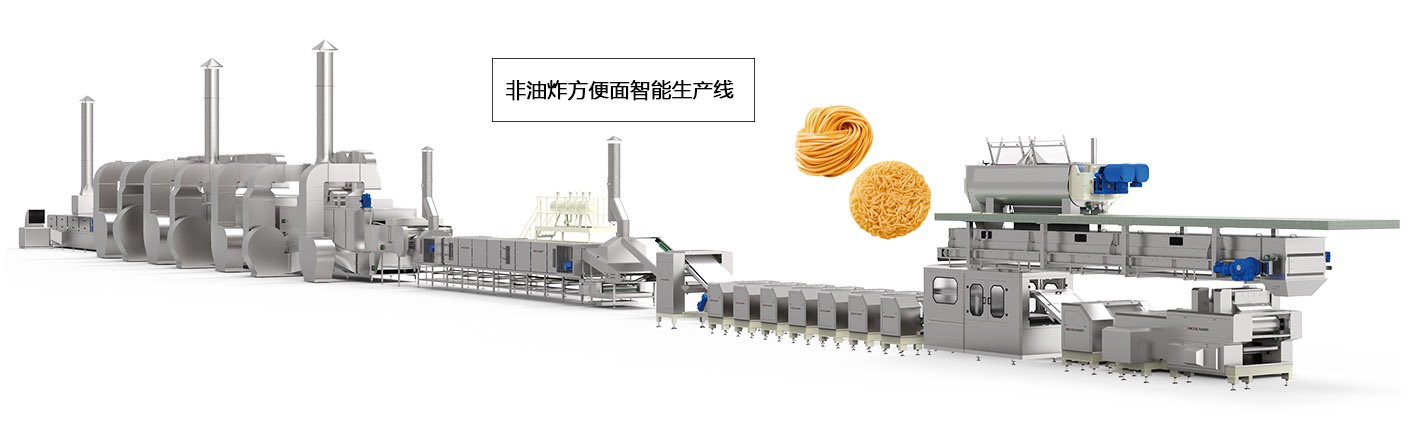
A vacuum dough mixer is used. In a vacuum, the sprayed water easily atomizes, ensuring even water distribution. There is no gas in the flour, allowing water to easily penetrate the interior, improving the mixing effect.
- Vacuum-mixed dough has a dense structure
- Vacuum mixing increases the amount of water added
- Vacuum mixing shortens the maturation time
- The dough generates less heat and has a lower temperature
Step 2 — Dough Maturation
This allows water to penetrate to the maximum extent into the protein colloidal particles, causing them to fully absorb water, swell, and adhere together to form a gluten network. Through low-speed mixing or resting, internal stress in the dough is eliminated, stabilizing the internal structure. It also ensures even feeding for the next compounding and sheeting process.
Step 3 — Rolling Process
The loose dough is rolled into fine, thin sheets of the specified thickness. Requirements include:
- Uniform thickness, smooth and flat
- No broken edges or holes
- Uniform color with a certain degree of toughness and strength
- Appropriately increasing rolling passes reduces the rolling ratio, benefiting the longitudinal distribution of gluten
Step 4 — Shredding
The dough sheet is divided into distinct shreds.
Step 5 — Steaming Process
This has a significant impact on the texture, rehydration properties, oil content, color, and transparency of the noodles. The steamer adopts a five-layer (multi-layer) design, extending the steaming time, improving the gelatinization degree of the product, and saving space, making the site layout more rational.
Step 6 — Noodle Cutting
After being steamed, the cooked noodles output from the steaming machine are rapidly cooled and sent to a roller bed with cutting blades. Each rotation of the rollers cuts the noodles into a certain length. Then, the dough is shaped into blocks.
Step 7 — Hot Air Drying & Cooling
A blower and a finned radiator using steam as a heat source are used in combination for segmented, circulating drying, ensuring uniform drying and minimizing energy consumption. Next, cooling is performed: the cooled dough sheets are kept close to room temperature or about 5°C above room temperature.
Post time: May-06-2026