
Ever watch a bowl of rice noodles go from a factory floor to your table and wonder what happens in between? You’re not alone. “How rice noodles are made in a factory” is one of the most common questions we hear from food buyers, plant managers, and curious home cooks alike. The honest answer: it’s not magic, but it’s not simple either. It’s a carefully choreographed sequence of steps where rice, water, heat, and time all have to show up at exactly the right moment.
In this guide, we’ll walk through the rice noodle production process step by step — the traditional logic behind it, the two main routes modern factories use, and where automation changes the game.
Two Ways to Turn Rice into Noodles
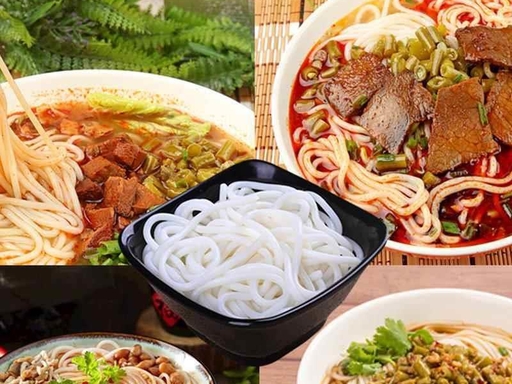
Before we get into the steps, it helps to know that “rice noodles” isn’t a single product. It’s a whole family — thin rice vermicelli, flat river noodles, round Yunnan mixian, the dried rice noodles used in Luosifen (snail noodles), and more. That said, almost all of them start from the same idea: turn rice into a smooth, cohesive mass, shape it, and set its texture.
Modern factories generally follow one of two routes:
Both routes share the same skeleton: clean the rice, milling it, shape it, set it, then dry or preserve it. Let’s walk through each stage.
Rice Noodle Production Process Step by Step
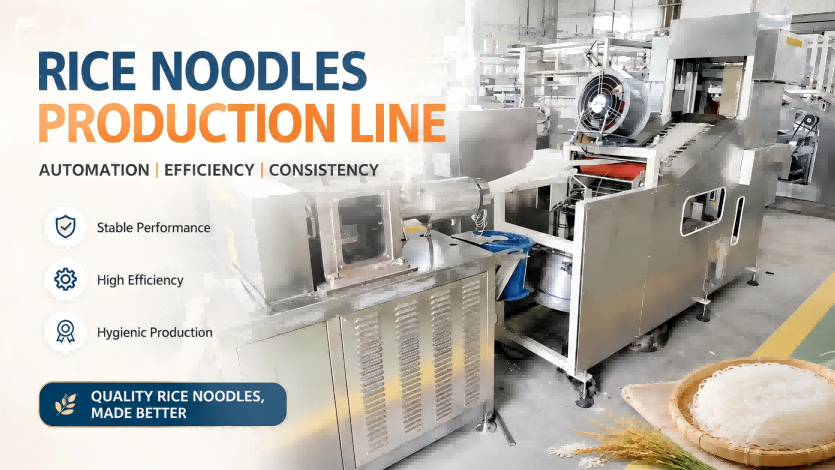
Here’s the full processing line, from raw grain to finished pack. We’ll follow the extrusion route, then note where the sheet-spreading method differs.
1. Blending and dosing the rice
Good rice noodles start with good rice — and usually more than one variety. Factories blend different rice types to hit a target starch profile, which is what gives the noodles their signature bite and gloss. On an automated line, a PLC-controlled blending system handles this precisely, so every batch comes out the same. This is where the “recipe” lives.
2. Washing, soaking, and draining
Next, the rice is washed to remove dust, husk, and any small stones, then soaked. Soaking isn’t just about softening — it hydrates the starch evenly so it mills and gelatinizes consistently later. After soaking, the water is drained and the rice is ready to grind.
3. Wet milling into slurry
The soaked rice is wet-milled into a fine slurry (or a fine powder for some dry processes). The goal is a smooth, uniform particle size, because lumps here become texture defects in the final noodle. On HICOCA lines, the slurry passes through a fine mesh so only properly ground material moves forward.
4. Mixing and resting
The slurry or flour is blended with water — and, for some recipes, a little starch or oil — to reach the right moisture content. Then comes a step people often forget: resting, or “waking” the dough. This short rest lets moisture distribute evenly and gives the starch a chance to relax, improving the final texture. It’s the noodle equivalent of letting bread dough proof.
5. Extruding and cooking (the self-cooking step)
Here’s the heart of the process. The prepared dough is fed into an extruder, where high temperature, pressure, and screw rotation gelatinize the starch and force it through a die to form strands. On a HICOCA self-cooking extruder, this “cooking” happens inside the machine — the starch reaches a gelatinization (maturity) level of 90% or more, which is why the noodles come out already cooked and springy rather than raw and chalky. Different dies produce different thicknesses, from fine vermicelli to thicker round noodles.
6. Cooling, separating, and cutting
Freshly extruded noodles are hot and sticky, so they pass through a cooling stage that removes heat and excess moisture. Then they’re separated so they don’t clump into a single block, and cut to length. On an automated line, a cutting-and-hanging machine handles this cleanly — spreading the strands, cutting them precisely, and hanging them on rods for the next stage. This is where a lot of manual labor used to live.
7. Aging (retting)
The cut noodles go into an aging chamber, where controlled temperature and humidity let the starch retrograde slightly. This firms up the structure, improves mouthfeel, and — importantly — reduces stickiness so the strands separate cleanly later. Think of it as the noodle “setting” into its final texture.
8. Soaking, loosening, and final shaping
After aging, the noodles are soaked and mechanically loosened (“rubbed apart”) so individual strands separate. Then they’re cut to their final length. For fresh wet rice noodles, this is close to the finish line; for dried noodles, one more big step remains.
9. Drying (for dried rice noodles)
Dried rice noodles need their moisture brought down to a stable level — typically around 14–15% — so they can sit on a shelf for months. This is done in a drying room with carefully controlled temperature and humidity. Done poorly, drying causes cracking, warping, or uneven texture; done well, it locks in quality. A note from our side: drying is usually the most energy-hungry part of the line, so good drying design matters for your electricity bill as much as your product.
10. Packaging and palletizing
Finally, the finished noodles are weighed, portioned, and packed — often automatically — before being boxed and palletized. Automated weighing and packaging also cut the risk of secondary contamination, which matters a lot for food safety.
(For the sheet-spreading method, the middle steps change: instead of extruding, the slurry is spread thinly onto a conveyor, steamed into a sheet, cooled, and then cut into strands. You gain finer control over thickness and a softer, more delicate texture — at the cost of more floor space and steam.)
Why an Automatic Rice Noodle Production Line Changes the World
If you’ve followed this far, you can probably see why a small workshop and a modern factory produce very different results, even with the same recipe. The rice noodle production process is full of steps where consistency is the whole ballgame — moisture levels, gelatinization degree, aging time, drying curves. Get any one of them slightly off, and the noodles stick, crack, or cook unevenly.
That’s exactly what an automatic rice noodle production line is for.
A well-designed line ties every stage together under PLC control: precise rice dosing, consistent extrusion, controlled aging, and even drying. A few things automation specifically buys you:
- ✓ · Consistency. Every batch comes out the same, because the process is controlled by parameters, not by feel.
- ✓ · Food safety. Less manual handling means fewer opportunities for contamination.
- ✓ · Lower labor cost. A line that used to need a dozen hands can often run with a handful of operators.
- ✓ · Energy efficiency. Smart drying and heat recovery can cut a major cost center.
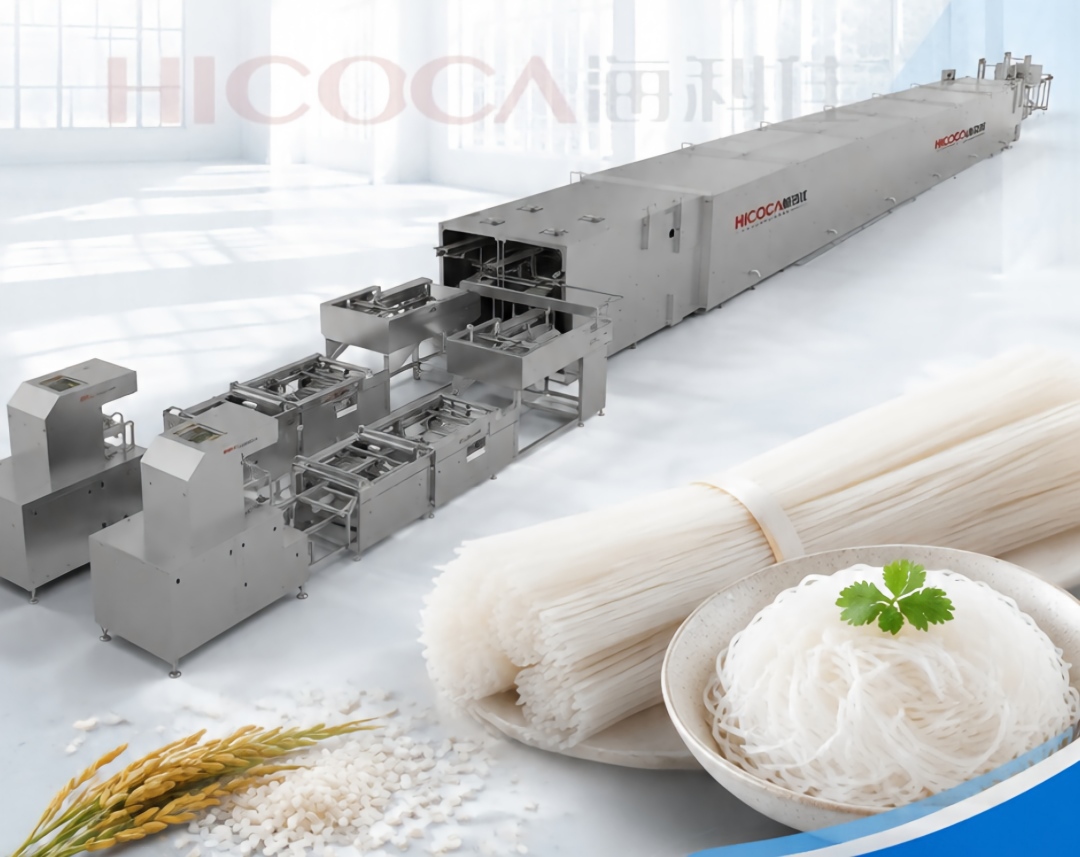
This is the part we know well. At HICOCA, we build turnkey rice noodle production lines — from fresh wet rice noodles to straight dried rice noodles — and we’ve shipped them to over 40 countries and regions. Whether you’re producing Jiangxi rice noodles, Guilin rice noodles, Liuzhou snail noodles, or Yunnan cross-bridge mixian, the principle is the same: get the process right, and the product takes care of itself
Common Questions About the Rice Noodle Production Process
What’s the difference between fresh and dried rice noodles?
Fresh wet rice noodles have a higher moisture content and a shorter shelf life, so they’re refrigerated or preserved. Dried rice noodles are dried to roughly 14–15% moisture and last much longer at room temperature.
How long does the whole process take?
It depends on the product. The forming steps run continuously, but aging typically takes several hours, and drying adds more time for dried noodles. A good line design keeps everything flowing so the plant stays busy.
What equipment do I need to start a rice noodle factory?
At minimum: rice washing and soaking, milling, mixing, extrusion (or steaming), cutting, and drying if you’re making dried noodles. A full line adds automation, aging chambers, and packaging. The exact list depends on your target product and capacity.
Can one line make different types of rice noodles?
Yes — within limits. Changing the die and adjusting parameters lets you switch between different thicknesses and shapes, and some lines handle both fresh and dried output with modular units.
Ready to See It in Action?
The rice noodle production process hasn’t changed in its essentials for centuries — rice, water, heat, and patience. What’s changed is how precisely we can control each step. If you’re planning to build or upgrade a rice noodle plant, we’d be glad to walk you through what a modern line looks like and what it would take to run one.
Post time: Sep-07-2026