
Global instant noodle consumption continues to create opportunities for food manufacturers. From mature Asian markets to emerging markets in Africa, Latin America, and the Middle East, instant noodles have always been an affordable and convenient food option. For manufacturers, understanding these consumer trends is crucial when planning production capacity, developing new products, and investing in automated instant noodle production lines.
According to the World Instant Noodles Association (WINA), global instant noodle demand reached 124.21 billion servings in 2025, Compared with 2024, this figure has increased by 0.7 percent. Although growth varies from country to country, the global market remains vast.
What do these trends mean for instant noodle manufacturers? Let’s take a look at the major consumer markets, evolving consumer preferences, and the production technologies that can help food manufacturers stay competitive.
1. Global Instant Noodle Consumption: Key Market Data
Instant noodles are no longer limited to just a few traditional markets. They have become a widely consumed food throughout Asia and are gaining increasing importance in other regions as well.
| Country or Region | Annual Demand in 2025 |
|---|---|
| China and Hong Kong | 43.27 billion servings |
| Indonesia | 14.54 billion servings |
| India | 9.60 billion servings |
| Vietnam | 7.46 billion servings |
| Japan | 5.95 billion servings |
| United States | 5.23 billion servings |
| Philippines | 4.34 billion servings |
| Thailand | 4.20 billion servings |
| South Korea | 4.06 billion servings |
| Nigeria | 3.12 billion servings |
Source: World Instant Noodles Association (WINA), 2025 demand data.
China and Hong Kong remain the largest combined market, while Indonesia continues to rank among the world’s most important instant noodle markets. India also saw significant growth, with demand rising from 8.82 billion servings in 2024 to 9.60 billion servings in 2025.
2. Asia Remains the Core Market for Instant Noodles
Given Asia’s deep-rooted noodle culture, large population, convenient retail distribution networks, and consumers’ familiarity with instant noodle products, the region continues to dominate the global instant noodle market.
Indonesia: A Major Market for High-Volume Production
In 2025, instant noodle consumption in Indonesia reached approximately 14.54 billion servings; based on total demand, the country has become the world’s second-largest instant noodle market.
For Indonesian food manufacturers, production efficiency is a key consideration. A modern instant noodle production line helps manufacturers integrate processes such as dough preparation, noodle forming, steaming, frying or drying, cooling, and packaging into a more continuous production flow.
India: A Market Showing Strong Demand Growth
In 2025, demand for instant noodles in India grew by approximately 8.9%, reaching 9.6 billion servings. Manufacturers should not focus solely on increasing output but should also consider adopting production systems that ensure consistent quality and allow for flexible adjustments to product specifications.
Vietnam and Other Southeast Asian Markets
Vietnam, the Philippines, Thailand, and other Southeast Asian countries have established mature markets for instant noodles. This diversity creates opportunities for manufacturers capable of efficiently producing different noodle sizes and packaging types.
3. Emerging Markets Offer New Opportunities for Manufacturers
Markets such as Nigeria, Egypt, Brazil, and Mexico have already established or are developing instant noodle industries. For manufacturers looking to enter these markets, there are several factors worth considering:
- • Local purchasing power: Product size, ingredients, and packaging costs must match the target market.
- • Local taste preferences: Seasonings and product specifications may need to be adapted to regional eating habits.
- • Distribution requirements: Products must be suitable for the intended retail and logistics channels.
- • Production economics: Energy consumption, labor requirements, raw materials, and maintenance costs all influence profitability.
- • Scalable capacity: Production equipment should match current demand while allowing reasonable future expansion.
4. Fried and Non-Fried Instant Noodles: Two Production Directions
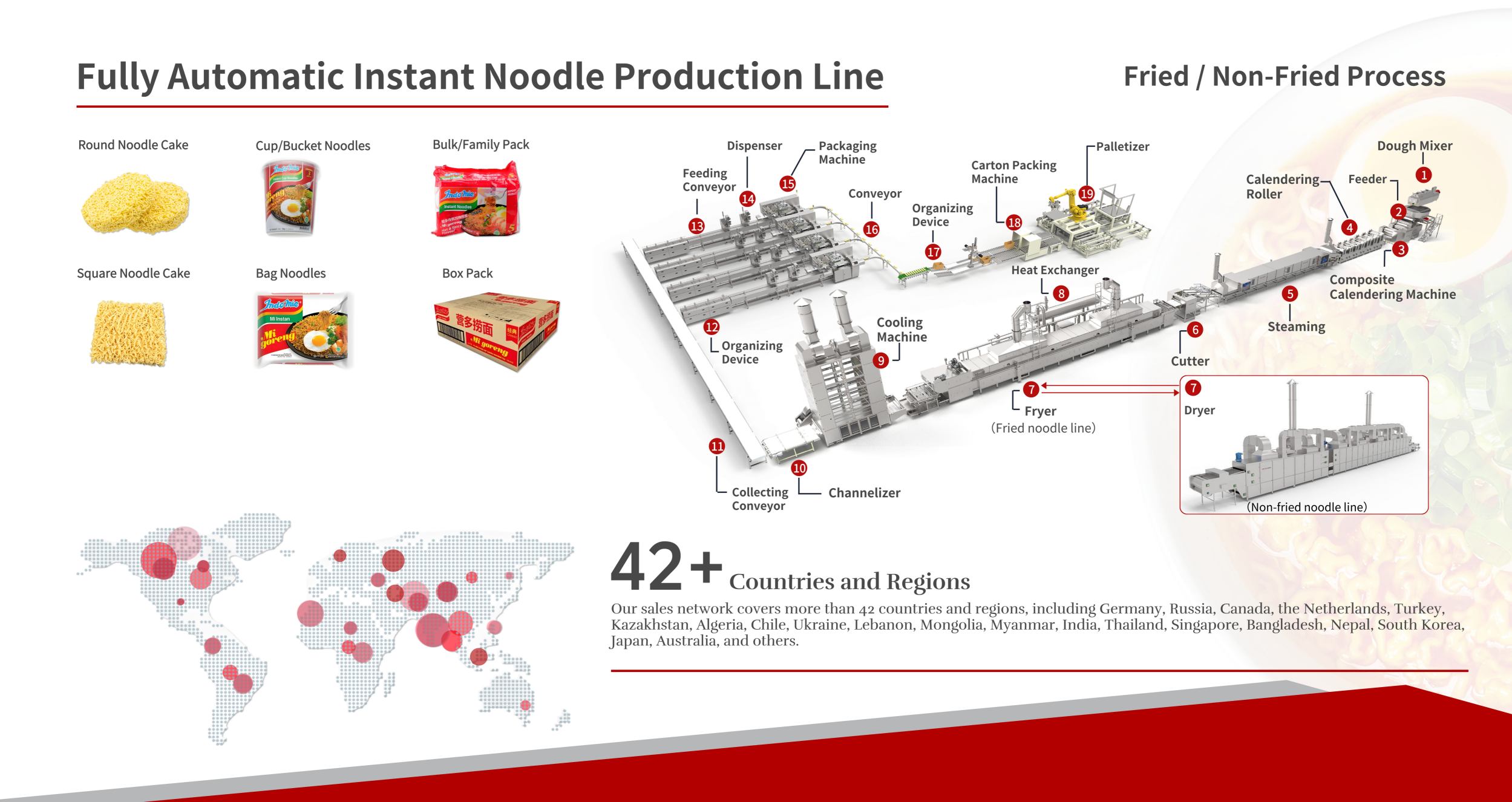
Fried Instant Noodles
Deep-frying helps reduce moisture content and creates a porous noodle structure, enabling rapid rehydration. Key considerations include stable frying conditions, oil control, and packaging efficiency.
Non-Fried Instant Noodles
Produced using hot-air drying. These may appeal to consumers who prefer non-fried products. Manufacturers should evaluate drying capacity and energy efficiency before selecting a line.
5. Product Diversification Is Becoming More Important
Manufacturers need to differentiate through Regional flavors, Different noodle formats (block vs cup), and Portfolio expansion (offering both fried and non-fried options).
6. Automation Is a Key Consideration for Instant Noodle Factories
Consistency Maintains stable operating conditions for dough shaping, steaming, and drying.
Efficiency Reduces repetitive manual work and optimizes factory workforce utility.
Packaging Matches packaging capacity to production output to avoid bottlenecks.
7. How Should Manufacturers Choose an Instant Noodle Production Line?
1. Target capacity: Realistic sales expectations.
2. Product type: Fried vs. Non-fried requirements.
3. Formats: Noodle shape and portion size.
4. Factory layout: Space and utility availability.
5. Economics: Complete assessment of ROI.
6. Supplier capability: Engineering and support.
7. Future expansion: Modular design possibilities.
8. HICOCA: Instant Noodle Production Line Solutions
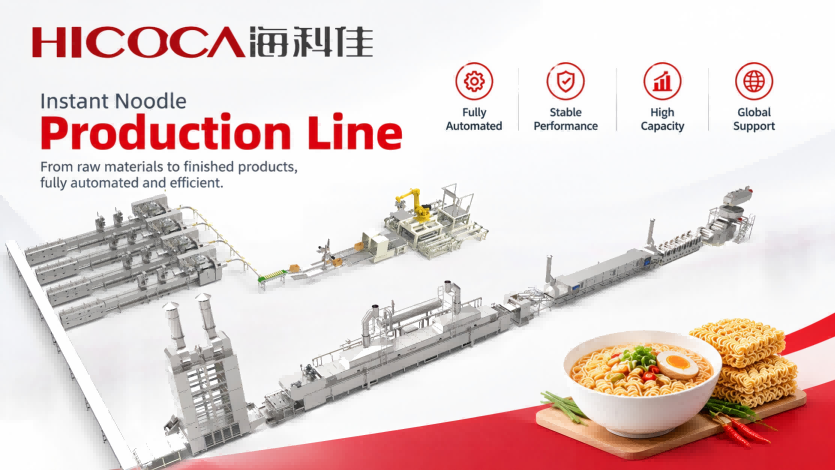
HICOCA provides food processing and packaging equipment for manufacturers looking to build or upgrade automated production facilities. HICOCA’s instant noodle production solutions are suitable for projects involving both fried and non-fried instant noodles.
Conclusion: Turning Global Consumption Trends into Production Opportunities
In 2025, global demand for instant noodles reached 124.21 billion servings. At the same time, market competition requires food manufacturers to pay closer attention to product diversification, processing efficiency, packaging performance, and long-term operating costs.
Planning a new instant noodle factory or upgrading your existing production line? Contact HICOCA to discuss your product requirements.
Sources and References
World Instant Noodles Association (WINA) – Global Instant Noodles Demand Rankings
Nissin Foods Holdings – 2025 Integrated Report
Data note: Global instant noodle demand figures refer to servings consumed during the year, not retail sales revenue.
Post time: Oct-22-2026