Key Industry Data: An in-depth look at the core figures from the “Report on the Development of China’s Rice Noodle Industry” — understand the true landscape of this trillion-yuan market in a single article. Covering everything from product categories and annual consumption statistics to production capacities across China’s 14 major production and sales provinces and the industry’s overall value — this is a must-save resource for industry professionals!
What are rice noodles?
Food products made primarily from rice; main types include dried rice noodles, fresh/wet rice noodles, and instant rice noodles.
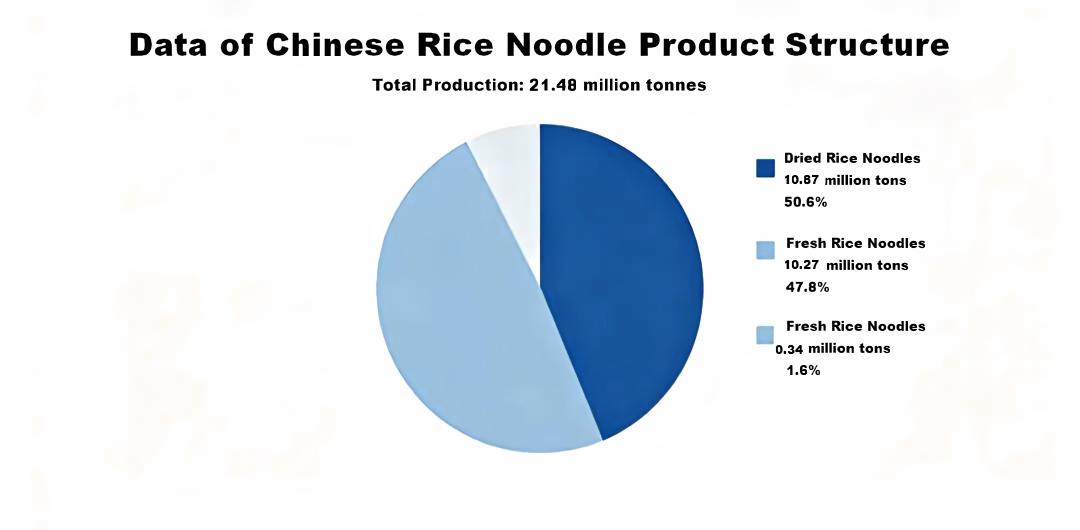
Overview of Chinese Rice Noodle Product Structure
China offers a wide variety of rice noodle products, with demand shaped by the distinct culinary characteristics of different regions.
Total combined production across 14 Chinese provinces/regions: 21.48 million tons
| Product |
Data |
Percent |
Types |
| Dried rice noodles |
10.87 million tons |
50.6% |
straight dried noodles, rice noodle cakes/blocks, instant rice noodle coils, dried wide flat noodles |
| Fresh/wet rice noodles |
10.27 million tons |
47.8% |
Fresh Pho, cylindrical fresh rice noodles, fresh rice noodles |
| Preserved rice noodles |
0.34 million tons |
1.6% |
Primarily cylindrical preserved rice noodles |
Industry Trend Observations: Dried rice noodles facilitate long-distance transport and are ideal for distribution and OEM (contract manufacturing) for instant foods; fresh/wet rice noodles serve local foodservice sectors, offering stable cash flow and moderate market entry barriers; preserved rice noodles represent an intermediate product category that has seen steady demand growth in recent years.
Comprehensive Overview of China’s 14 Major Rice Noodle Production & Sales Provinces
This analysis covers the 14 provinces, regions, and municipalities with the highest concentration of rice noodle production and sales, totaling 21.48 million tons. Ranked by production capacity, these regions exhibit significant differences in product structure, consumption habits, and leading enterprises—serving as a crucial reference for companies planning their market strategies.
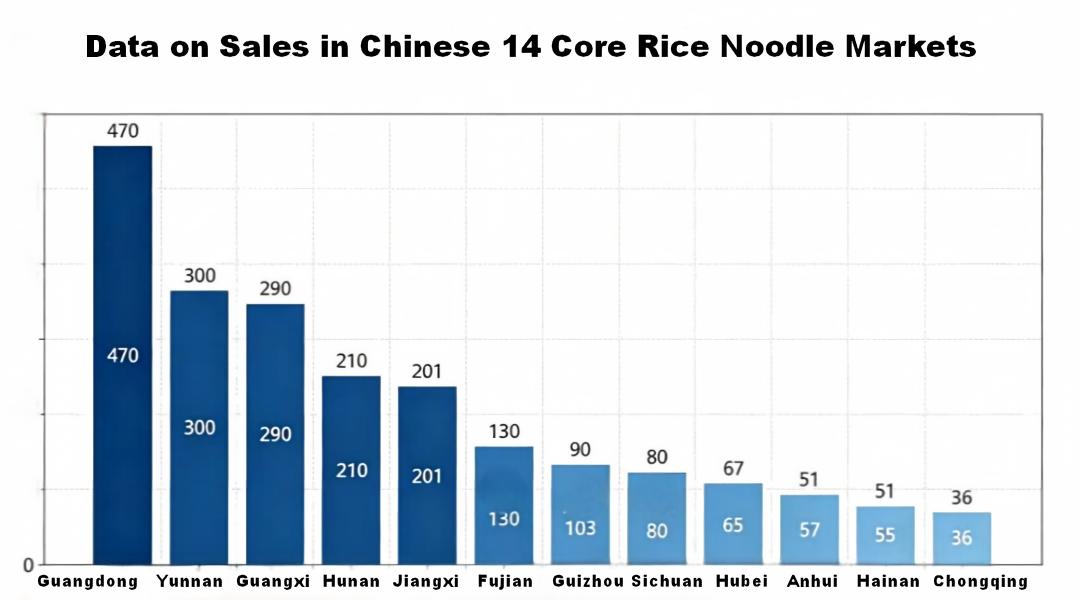
Guangdong | Total output: 4.7 million tons
| Dried rice noodles |
Bundled rice vermicelli blocks, flat wide rice noodles, instant dried Pho, straight dried rice vermicelli, flat rice noodles, and others |
| Fresh rice noodles |
Fresh/wet pho rice noodles is the primary product |
| Market characteristics |
Rice noodles are deeply ingrained in local culture; a massive consumer market is supported by both the resident population and huge tourist inflows |
| Factory |
Bawanghua Food, Chencun Food |
Yunnan | Total output: 3 million tons
| Primary categories |
Fresh/wet rice noodles; also features regional specialties like thick, sliced rice noodles and round rice noodles |
| Market characteristics |
Strong local consumption base and a rich variety of specialty rice noodle products |
| Factory |
Hengyang Food, Minsheng Food, Zhixiang Grain & Oil |
Guangxi | Total output: 2.9 million tons
| Core feature |
“luosifen” (river snail rice noodle) supply chain drives demand for dried rice vermicelli; also produces large quantities of fresh/wet and preserved rice noodles |
| Market characteristics |
Viral *luosifen* products boost the industry, while tourism continues to drive rice noodle consumption |
| Factory |
Lehaha Food, Youfen Food, Guilin Kangle-ren Noodle Industry |
Hunan | Total output: 2.1 million tons
| Product mix |
A “tripartite” balance among fresh/wet rice vermicelli, fresh/wet “hefen”(Pho rice noodles), and straight dried rice vermicelli |
| Market characteristics |
Hunan rice noodles possess strong brand recognition as a culinary icon; local demand is extremely robust |
| Factory |
Yinzhou Co., Ltd., Xinsanxiang Changde Rice Noodle Group, Tiantian Food |
Jiangxi | Total output: 2.01 million tons
| Product |
Outstanding production capacity for straight dried rice vermicelli; also features specialty shaped rice noodles like macaroni-style and shell-shaped varieties |
| Market characteristics |
One of the birthplaces of traditional dried rice vermicelli; possesses strong export capabilities |
| Factory |
Wufeng Food, Chunsi Food, Magu Food, Baoxing Rice Industry |
Fujian | Total output: 1.3 million tons
| Product |
Straight dried rice noodles, coiled dried rice noodles, fresh wet rice noodles |
| Market characteristics |
Mature coiled rice noodle industry; well-established domestic and international distribution channels |
| Factory |
Jianhao Food, Chengxin Food |
Guizhou | Total output: 1.03 million tons
| Product |
Primarily fresh wet rice noodles and straight dried rice noodles; supplemented by preserved rice noodles and instant tray-packed rice noodles |
| Market characteristics |
Stable local demand; continued growth in tourism-related dining |
| Factory |
Jinchen Agricultural Products, Huangguoshu Central Kitchen |
Zhejiang | Total output: 900,000 tons
| Product |
Coiled dried rice noodles, straight dried rice noodles, fresh wet sliced rice noodles |
| Market characteristics |
Moderate rice noodle consumption; high number of distribution-oriented factories |
| Factory |
Tianzhu Rice Noodles, Fenghe Grain & Oil, Daohuaxiang Food |
Sichuan | Total output: 800,000 tons
| Product |
Straight dried rice noodles; relatively small volume of fresh wet rice noodles |
| Market characteristics |
Stronger local preference for wheat-based noodles; rice noodle consumption relies heavily on specialty dining and tourism |
| Factory |
Yinfeng Food, Wangfuwang Food, Fuxi Food |
Jiangsu | Total output: 670,000 tons
| Product |
Coiled dried rice noodles, straight dried rice noodles, small amounts of fresh wet rice noodles, instant tray-packed rice noodles |
| Market characteristics |
No large-scale leading rice noodle enterprises; residents prefer wheat-based noodles, limiting domestic demand |
Hubei | Total output: 650,000 tons
| Product |
Straight dried rice noodles, cylindrical instant tray-packed rice noodles |
| Market characteristics |
Wheat-based noodles dominate; rice noodle consumption is concentrated in specific cities |
| Factory |
Meishiyuan Food, Yuanyuan Food, Chufeng Quanyuan Agriculture |
Anhui | Total output: 510,000 tons
| Product |
Primarily straight dried rice noodles, complemented by fresh-wet and shelf-stable rice noodles (mixian) |
| Market characteristics |
Regional market leaders hold a distinct advantage; demand is driven by rice noodle restaurant chains |
| Factory |
Wangrenhe Mixian, Fubang Tiancheng Food, Chuncheng Laobaijia |
Hainan | Total output: 550,000 tons
| Product |
Fresh-wet “hefen” (wide flat rice noodles), fresh-wet rice noodles, and bundled dried rice noodles. |
| Market characteristics |
Large tourism market, yet limited options for rice noodle consumption. |
| Factory |
Currently, there are no large-scale rice noodle manufacturing enterprises. |
Chongqing | Total output: 360,000 tons
| Product |
Straight dried rice noodles, fresh-wet rice noodles, and shelf-stable rice noodles. |
| Market characteristics |
Wheat-based noodle consumption dominates; limited room for growth in the rice noodle market. |
| Factory |
Sanyi Xian Food, Sanzu Food. |
Social Value of the Rice Noodle Industry: Employment, Income, and Profitability
Based on comprehensive calculations using 2024 national rice noodle production and sales data, actual factory labor efficiency, and statistics from provincial/municipal industry and information technology departments:
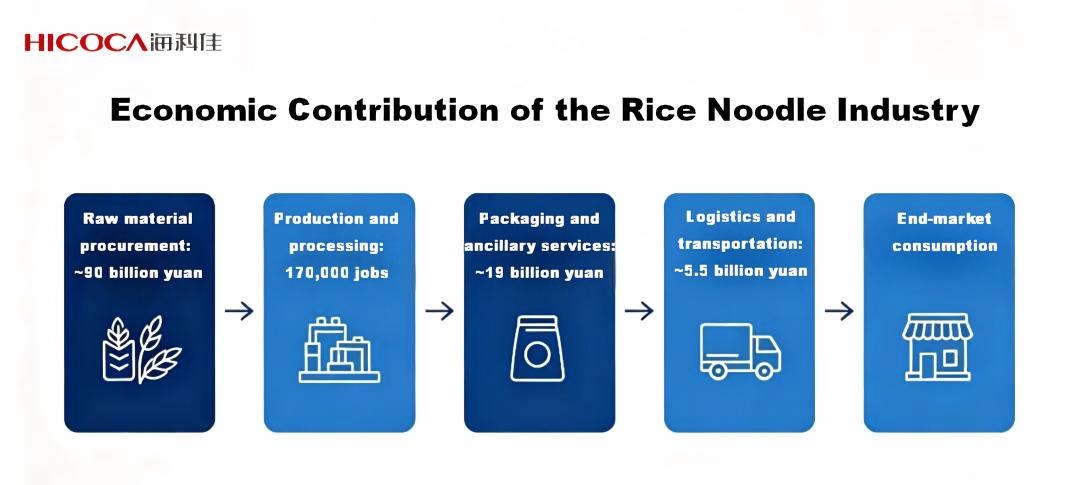
The national rice noodle industry directly employs approximately 170,000 people.
- ▪ Large-scale enterprises: Employ approx. 120,000 people; focus on dried rice noodles; per-capita daily output of 400–450 kg.
- ▪ Small and medium-sized factories: Employ approx. 50,000 people; focus on fresh-wet rice noodles; per-capita daily output of 300–350 kg.
*Note: Statistics exclude personnel in extended supporting sectors, such as pre-packaged instant rice noodles.
Income range for industry personnel
- ▪ Front-line production staff: Annual income generally ranges from 50,000 to 60,000 RMB, depending on regional economic differences.
- ▪ Technical and management roles: Annual income ranges from 80,000 to 200,000 RMB.
Industry profitability and tax burden
- ▪ Overall industry profit margin range: 15%–35%.
- ▪ Significant differences: Profit margins in the shelf-stable rice noodle segment are relatively low, with pre-tax margins of 5%–15%.
- ▪ Taxation: Standard product tax rates apply. 13%; after input tax deductions, the enterprise’s actual composite tax rate is 2%–5%.
Upstream and downstream industry chain effects
The rice noodle industry extends beyond mere production; it strongly drives three major sectors—packaging, logistics, and grain raw materials—forming a complete industrial ecosystem.
Packaging Market
Value: ~19 billion yuan
Plastic crates: 1.15bn units | 14.6bn RMB
Woven bags: 240m units | 260m RMB
Plastic bags: 950m units | 200m RMB
Small bags: 3.8bn units | 450m RMB
Color bags: 3.4bn units | 950m RMB
Cartons: 630m units | 2.5bn RMB
Logistics & Distribution
Volume: ~45 million tons
Driving annual logistics industry revenue of approximately 5.5 billion yuan through the circulation of raw materials and finished goods.
Grain Procurement
Value: ~90 billion yuan
- Rice/Paddy: 18m tons | 64bn RMB
- Starch: >9m tons | 26bn RMB
Summary: The rice noodle industry is a quintessential agriculture-related industry that boosts local prosperity.
Industry Insights
01. South China and Southwest China are the core hubs for rice noodle consumption and production;
02. Product formats vary significantly across provinces; cross-regional plant construction requires customized equipment and product strategies;
03. Fresh wet rice noodles remain localized, while dried rice noodles offer nationwide and export potential;
04. Automated lines, upgraded preservation, and restaurant chain customization will be the core drivers of future growth.
Note: The data in this article is compiled from the “Report on the Development of Chinese Rice Noodle Industry” and is intended for industry reference and exchange.
Post time:
Oct-12-2026