
At 10 a.m., the city’s hustle had yet to fully awaken. I navigated an unassuming alley, eventually finding a small Japanese eatery tucked into the ground floor of a residential complex. It had been open for five years. The storefront was modest—so discreet, in fact, that passersby might easily overlook it unless they were actively seeking it out.
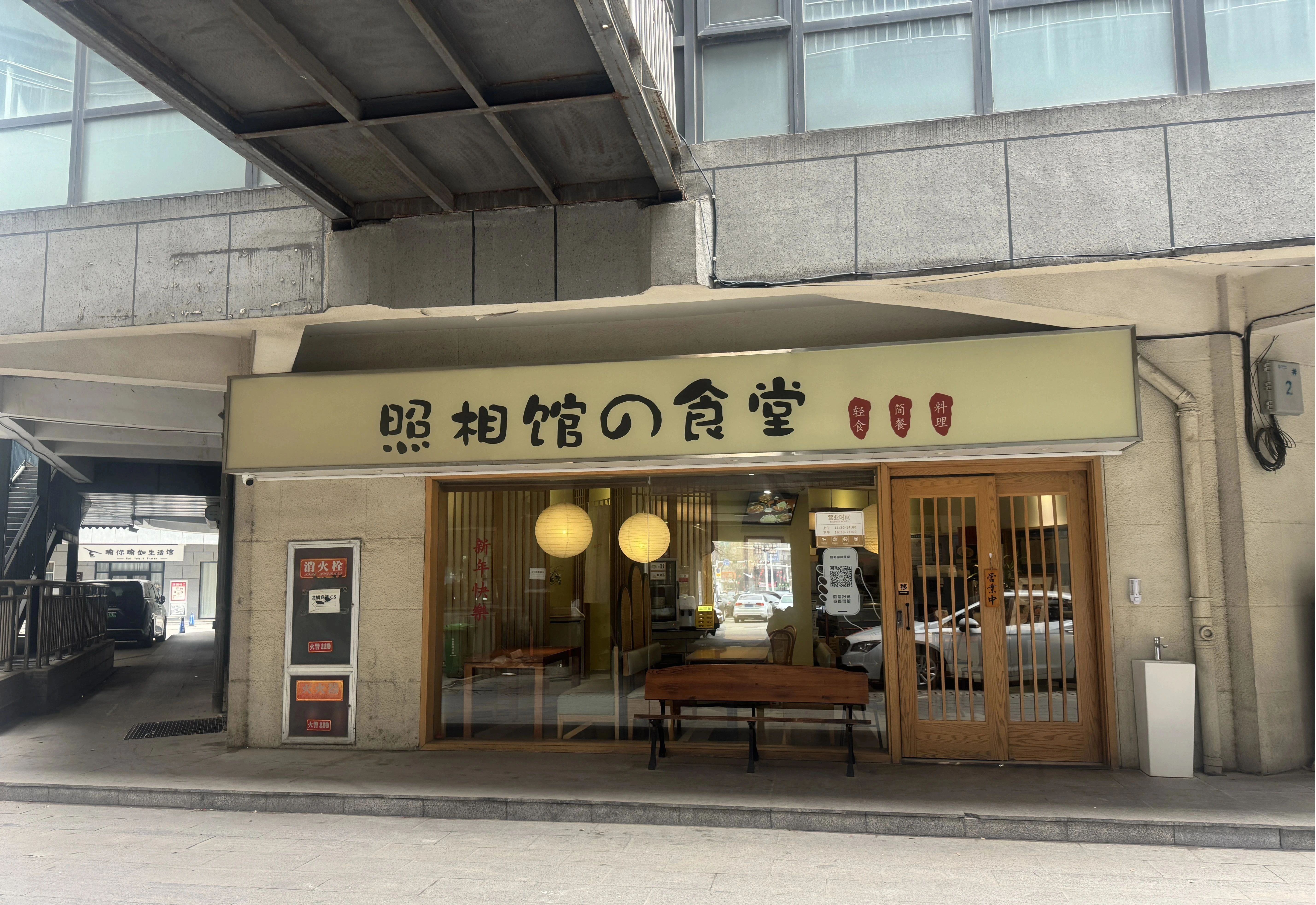
The moment I pushed open the door, a wave of wheat flour aroma greeted me.
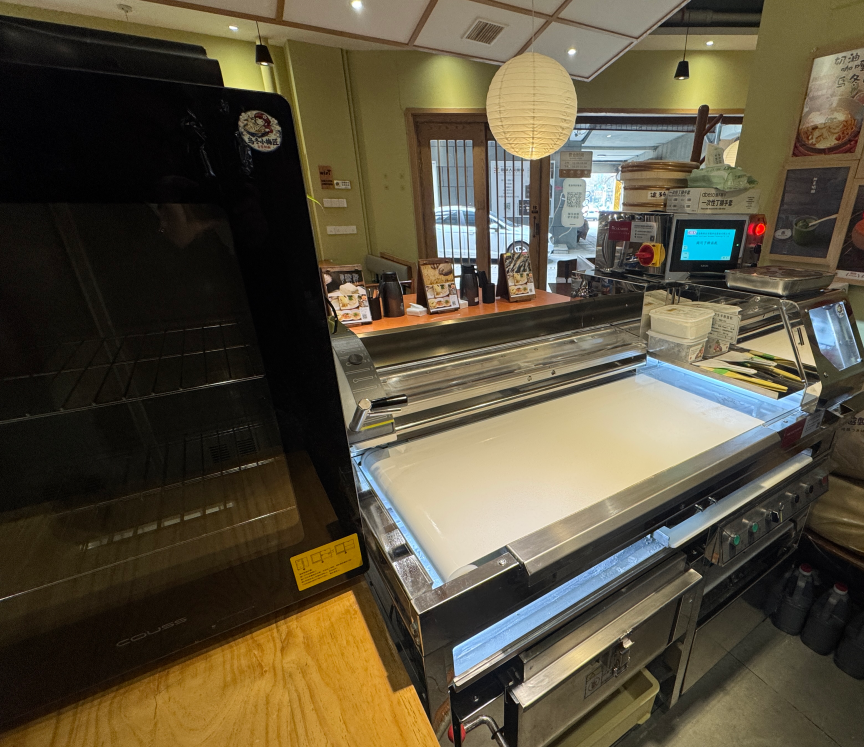
Kong, the owner, was already busy in the kitchen. This post-85s entrepreneur stood before a HICOCA udon machine, meticulously tending to every step—kneading, pressing, rolling, and cutting—with unwavering focus. The shop hadn’t officially opened yet, but he was already immersed in his own world: a world of udon.
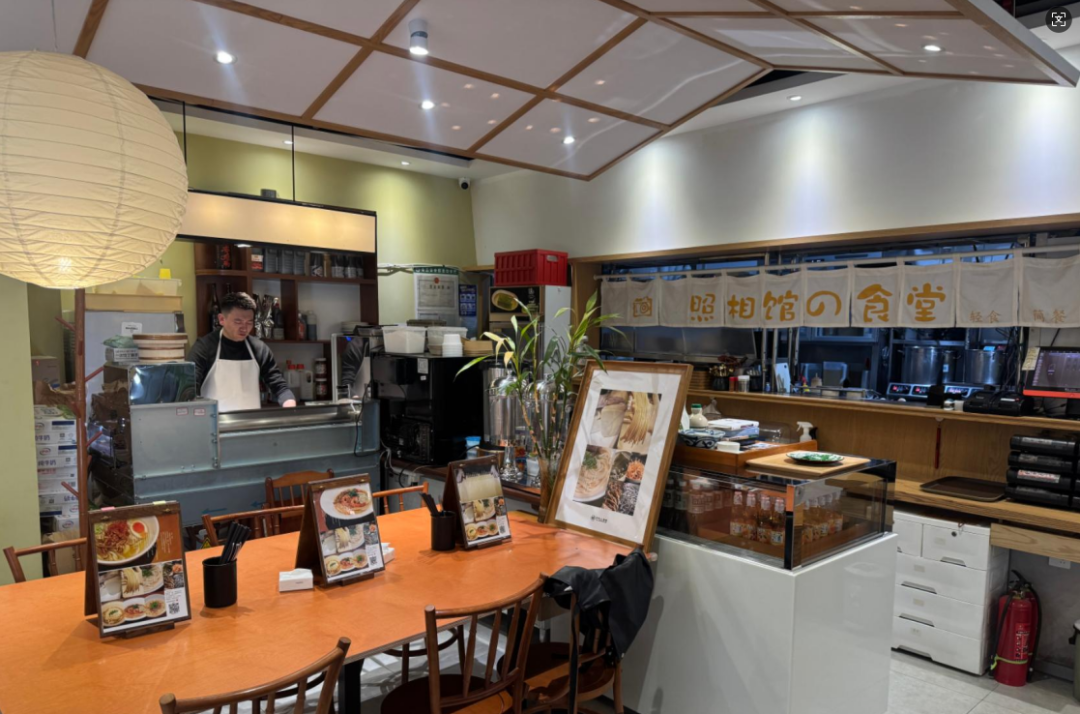
“I’ve been researching this for five years.”
Xiao Kong didn’t look up, his eyes fixed on the dough blocks slowly ex
truding from the machine. The fully rested dough exhibited perfect elasticity, its texture as delicate as a baby’s skin.
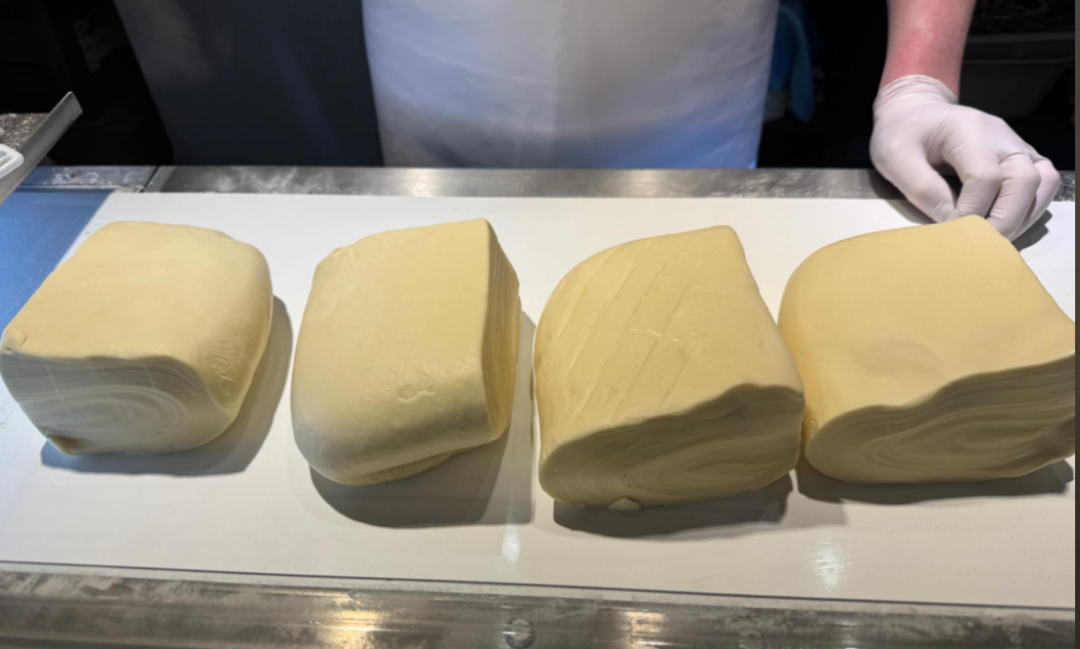
12 rolling stages.
This is HICOCA’s most impressive design feature. It’s not about crude, one-step molding, but a progressive, hand-mimicking rolling process. Each pressing awakens the gluten network within the flour, weaving them into an invisible—yet palpable—web of elasticity.
When Xiao Kong lightly tapped the touch screen, white udon strands fell uniformly from the cutter onto the collection tray. In that moment, I saw the light in his eyes.
It was the glow of a craftsman witnessing his dream come true.
“Look,” he grabbed a bundle of freshly cut noodles and gave a light tug. They bounced twice in the air. “This is what udon should look like.”
He skillfully dusted the noodles with starch to prevent sticking, then coiled them into boxes. His movements were fluid, as if he had done this thousands of times.
In less than an hour, 50 catties (approx. 60 lbs) of udon were neatly stacked.
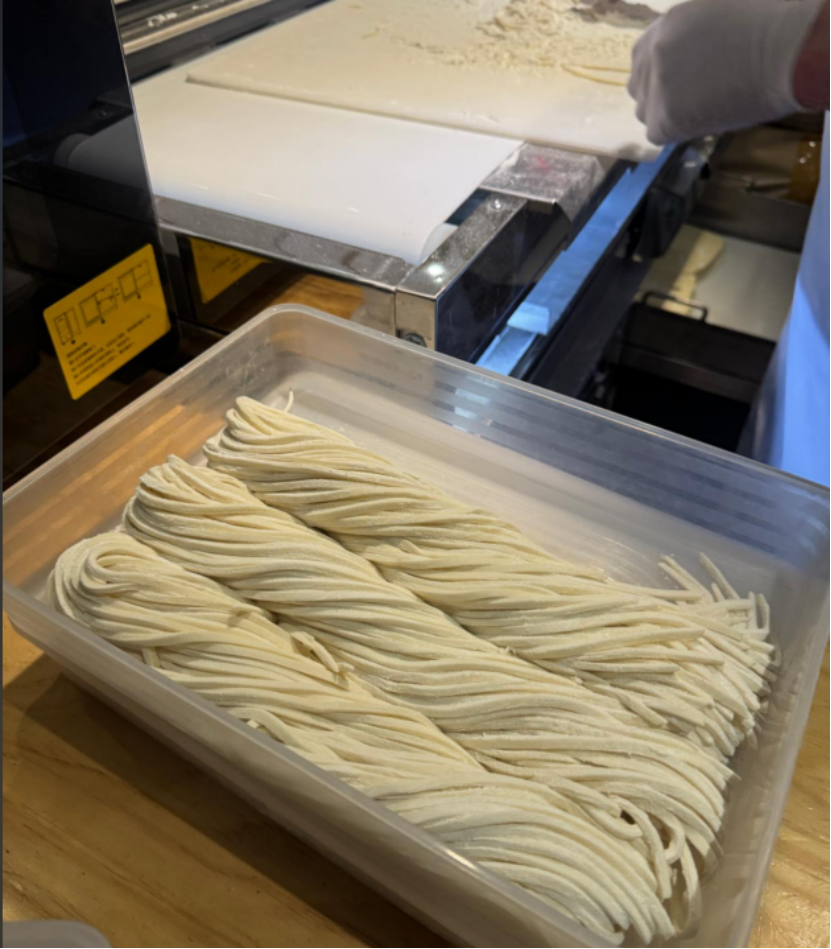
If made entirely by hand, this amount would require a master craftsman to work non-stop for a full day. Here, efficiency and quality were no longer opposing forces.
“I always wanted to focus on udon,” Xiao Kong finally looked up, wiping a light sweat from his brow. “But I couldn’t find the right equipment. Machines on the market either made the noodles too hard, lacked chewiness, or felt too industrial—soulless.”
“Until I met yours.”
I smiled, saying little. At that moment, I was more eager for the bowl of noodles about to be served.
Thai Golden Curry Prawn Udon
Five minutes of waiting isn’t long, but for someone who had just witnessed the entire process, every second was agony.
The dish finally arrived.
The curry’s aroma aggressively invaded my nostrils. The golden sauceed chewy shrimp, while the protagonist—the coil of udon—lay quietly in the bowl, waiting for my chopsticks.
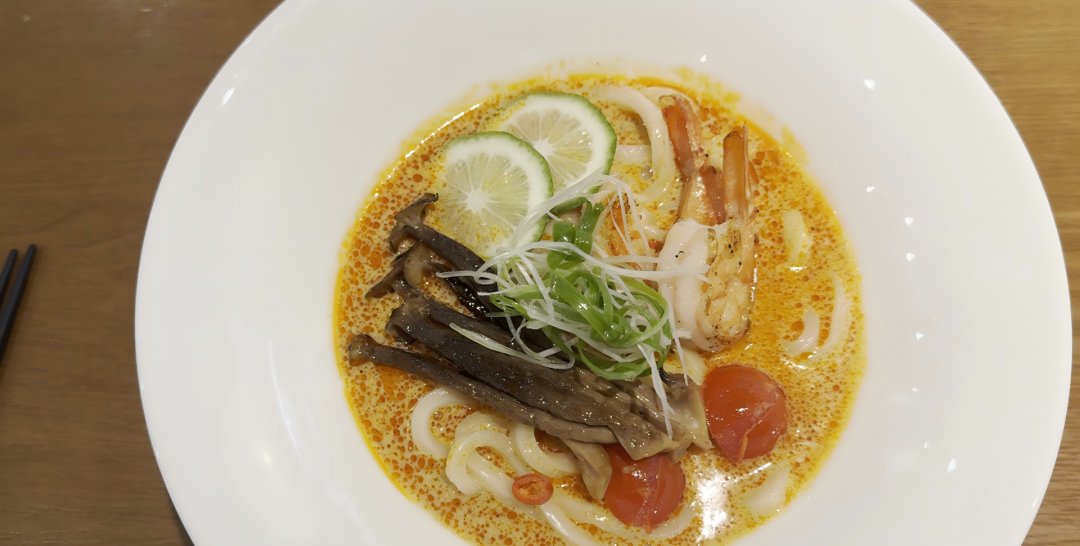
The first bite.
How do I describe that texture?
I had eaten at a renowned shop in Tokyo, hailed as one of “Japan’s Three Great Udon,” and thought I knew what good udon was. But this bite still stunned me.
It wasn’t simply “chewy” . The word “chewy” is too thin to describe the subtle resistance felt when teeth cut through the noodle. Nor was it purely soft and glutinous, as that term fails to explain the layered wheat aroma and sweet aftertaste released during chewing.
It wa stoughness,moistness, Smoothness, Glutinousness.
It was a wonderful symphony of these sensations intertwining in the mouth. More accurately, the machine had replicated the “cause” of handcrafting, yielding a “result” that surpassed it. The perfect gluten network, built through 12 stages of rolling, ensured that every noodle maintained just the right tension after cooking—neither limp and shapeless nor hard and difficult to chew. It gently bounced between the teeth, and just as you were about to overlook it, released a final trace of wheat fragrance.
“Our customers are basically all regulars.”
Xiao Kong sat across from me, watching me eat with satisfaction. A smile unique to shop owners—one of pure contentment—spread across his face.
“Some call us an ‘internet-famous shop’ and want us to promote more on Xiaohongshu and Douyin,” he said, shaking his head. “But I refused.”
“Why?” I asked.
“Because the term ‘internet-famous shop’ is an insult to us.” His tone was calm but firm. “‘Internet-famous shops’ chase traffic and momentary popularity. What we chase is that, five or ten years from now, people will still be willing to cross this alley specifically to eat a bowl of noodles.”
“We live by quality. We live by heart.”
I put down my chopsticks and looked earnestly at the young man before me. Five years ago, he opened a small shop in this hidden corner, guarding a steadfast dedication to Japanese cuisine. Five years later, he finally found the right equipment, allowing his five-year dream of perfect udon to take root. And HICOCA was fortunate to become a part of this dream.
Some say machines are cold, industrial, and soulless. But they don’t know that machines are merely tools. The soul always comes from the person who wields them.
Xiao Kong wasn’t using this machine to produce standardized, assembly-line products. He was crafting the very bowl of noodles he had researched for five years. He controlled the kneading time, monitored the dough’s proofing, adjusted the rolling pressure, and infused his own understanding into every detail. It was the precision of the machine, combined with human dedication, that created that moment of sheer delight.
As I left, I turned back for one last look at the small shop. The storefront remained unassuming, the location still hidden. But I knew that behind that door, a young man was making a true bowl of udon in the most “foolish” yet wisest way possible. He had waited five years for the right machine, then used his daily devotion to transform that long wait into the惊艳 (astonishing delight) found in every diner’s bowl.
This is not an “internet-famous” shop.
This is a shop worth crossing half the city to visit.
Postscript
At HICOCA, we have encountered countless people in the food and beverage industry. Some chase speed, hoping for machines that are as fast as possible; others prioritize cost, seeking the cheapest options available; still others look for convenience, desiring machines that are as “foolproof” as possible.
But we have also met people like Xiao Kong.
They do not pursue the fastest, the most economical, or the cheapest. What they seek is that one “right” taste.
Our udon noodle machine was born precisely for such individuals. With 12 stages of rolling that mimic handcrafting layer by layer, intelligently controlled precise parameters, and a user-friendly interface—every design choice was made not to replace craftsmanship, but to allow a craftsman’s dream to be tasted by more people.
If you are such a person, if you too have a bowl of noodles you’ve been waiting a long time to perfect—welcome to talk with us.
Perhaps what you are waiting for is not just a machine.
Perhaps what you are waiting for is a partner who can faithfully transmit your dedication, in its entirety, to every diner.
Post time: Mar-14-2026